


Trading Journal Risk: A Guide to Position Sizing & Exposure
Table of Contents
Why Risk Documentation is Crucial for New Traders
After a few months of trading, you might notice that despite studying technical analysis and following signals, your account balance is still pretty volatile. One day, you realize several trades that seemed well-managed ended up costing more than expected.
This is where risk documentation comes in – it helps prevent costly mistakes by tracking your risk management strategies. For example, if you set a mental stop-loss while entering a trade when the RSI indicator shows an overbought condition, without writing it down, you’re likely to waver under market pressure and deviate from your plan.
On the other hand, documenting your risk parameters – like setting a 2% stop loss on your account value – keeps you accountable. It ensures that you stick to your initial strategy during volatile times, thus avoiding bigger losses.
By putting your risk management decisions in writing, you force yourself to be clear and consistent about them. This reduces emotional decision-making when markets are stressful and helps each trade align with your predefined risk tolerance. Without this practice, new traders often find it hard to stick to their strategies, which can lead to significant financial loss.
So, documenting your risks isn’t just a good idea; it’s essential for managing your trading effectively.
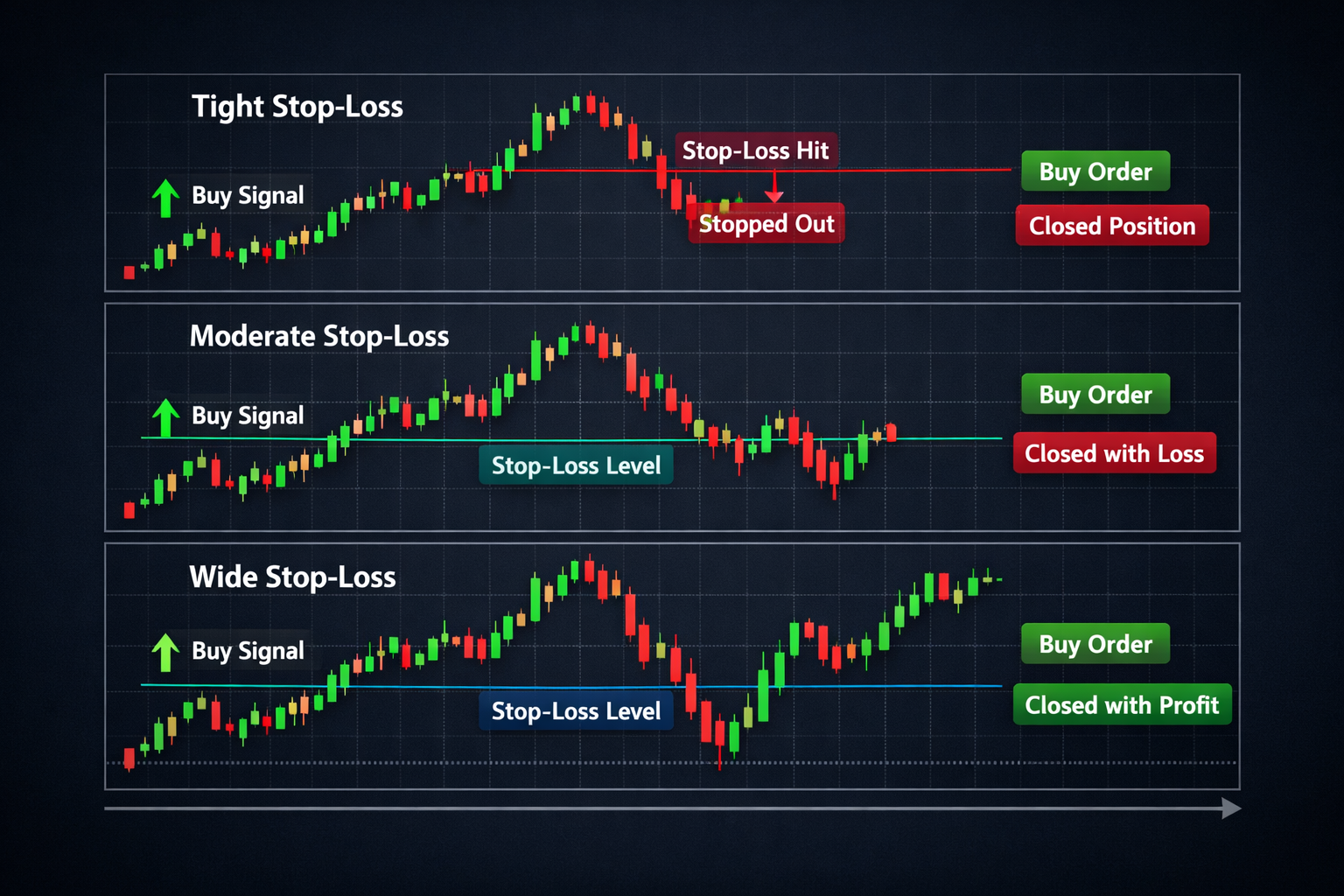
Setting Stop-Loss Levels: A Practical Guide
Before setting a stop-loss level, figure out how much risk you’re comfortable with. For example, if you have a $5,000 account and want to risk 2% per trade, you can afford to lose $100.
Next, use tools like the RSI indicator to gauge market volatility. If the RSI shows overbought or oversold conditions, adjust your stop-loss levels to account for bigger price swings. Technical Analysis offers more details on these movements.
For instance, if you buy stock at $100 and are willing to risk 5%, set your stop loss at $95.
Keep track of your decisions in a trading journal so you can review past choices and improve future strategies. Trading Journal is crucial for this.
Regularly update your stop-loss levels as market conditions change. For example, tighten your stop loss if volatility spikes due to news events.
Don’t set stop-loss levels randomly without considering both the market and your risk tolerance. This can lead to unnecessary losses or missed opportunities. By following these steps, you keep your trading strategy protected and flexible.
Position Sizing Rationale: Balancing Reward and Risk
When deciding on your position size, start by figuring out what percentage of your account balance you’re willing to risk on each trade. This helps ensure that your trades match your overall risk tolerance and financial capacity.
- Calculate Position Size Based on Risk Tolerance:
- Determine the maximum drawdown per trade, usually between 1% and 5%.
- For a $10,000 account risking 2%, you can afford to lose up to $200.
- Adjust this percentage based on your comfort level with market volatility.
- Set Stop-Loss Levels:
- Place stop-loss orders according to your risk management plan.
- Use technical analysis tools like RSI or chart patterns to set stops accurately.
- Make sure your stop-loss triggers before significant losses accumulate, locking in smaller losses instead of larger ones.
Incorrect Approach: Deciding position size based only on the strength of a trade setup can lead to overexposure and unexpected drawdowns. For example, investing too much in an aggressive trade with weak signals risks substantial account erosion.
- Balance Reward Against Risk:
- Calculate potential profit for each trade.
- Compare this to your maximum allowable loss.
- Optimize position size by balancing the reward-risk ratio, aiming for higher returns relative to risk taken.
By systematically calculating position sizes based on a percentage of your account balance and setting stop-loss levels accurately, you can manage risk effectively while maximizing potential gains. Regularly adjusting these settings in response to market changes is crucial for long-term success.
Next step: Document every trade’s position size and outcomes in your trading journal.
Factors Influencing Position Size Decisions
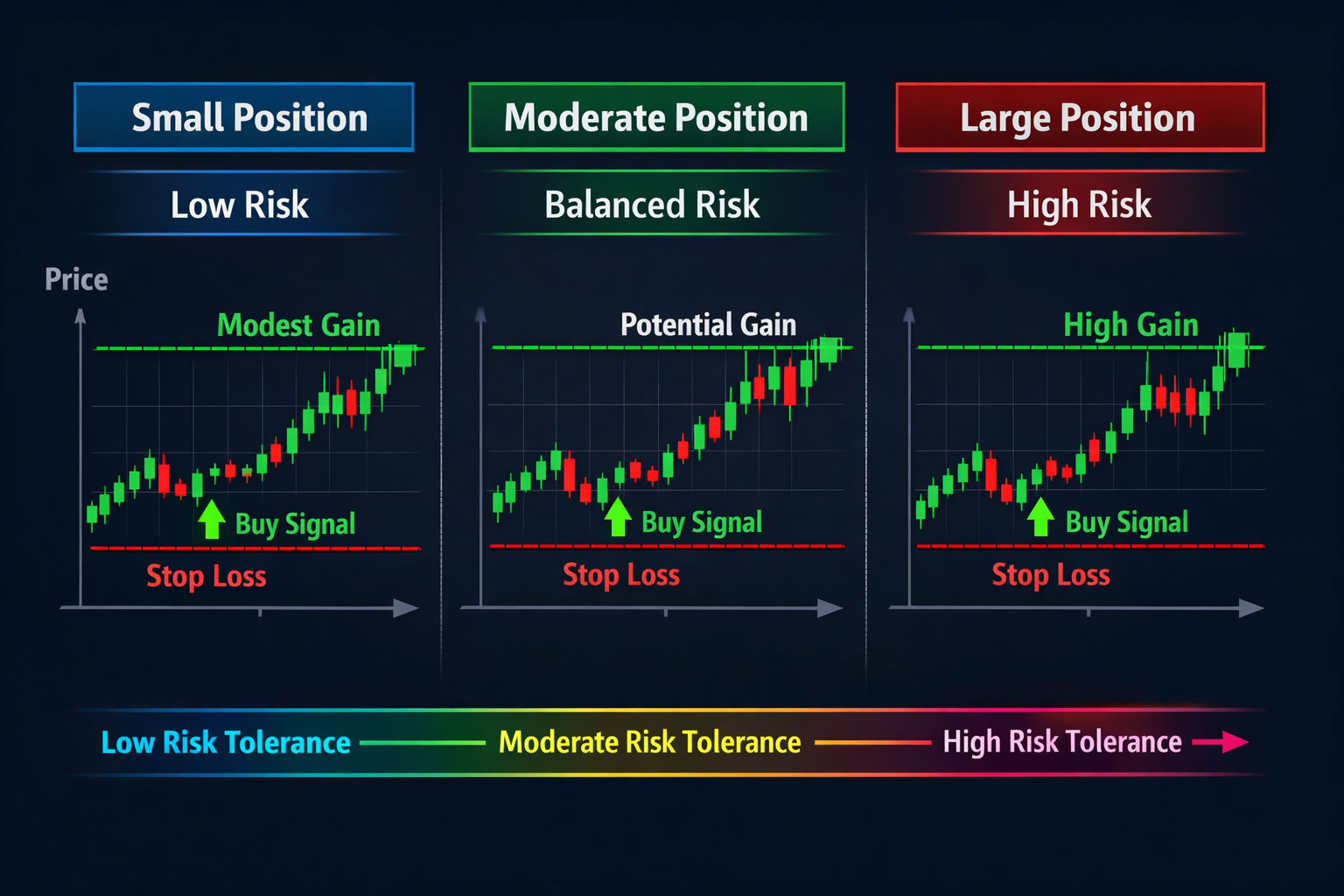
What factors influence position size? New traders often struggle with figuring out how much of their account to risk on each trade. Key factors include risk tolerance, account size, and trading objectives.
For instance, if you have a $5,000 trading account and are okay risking no more than 2% per trade, that means you’ll risk $100 per trade. This helps protect your entire account even if the market moves against you. Ignoring these factors can result in severe losses or overly conservative positions.
Your risk tolerance plays a big role: if you’re cautious and prefer smaller but more frequent wins, you might choose smaller position sizes compared to someone who’s willing to take bigger risks for potentially higher returns.
Here’s an example: A trader with a $10,000 account decides they want to trade a stock that has been trending upward after analyzing chart patterns. If their risk tolerance is low and they aim for stability over aggressive growth, they might opt for a position size of 1% per trade, risking only $100.
This approach helps maintain financial stability by limiting potential losses while still allowing room for profit. Ignoring these nuances could result in either excessive risk or missed opportunities due to overly conservative sizing.
To put it into practice, start by assessing your own risk tolerance and trading objectives before calculating position size based on your account balance. This way, you can tailor your approach to fit your unique financial situation and personal comfort level.
Next step: Document your risk tolerance and trade goals in your trading journal for future reference.
Tracking Total Exposure: Maintaining Financial Control
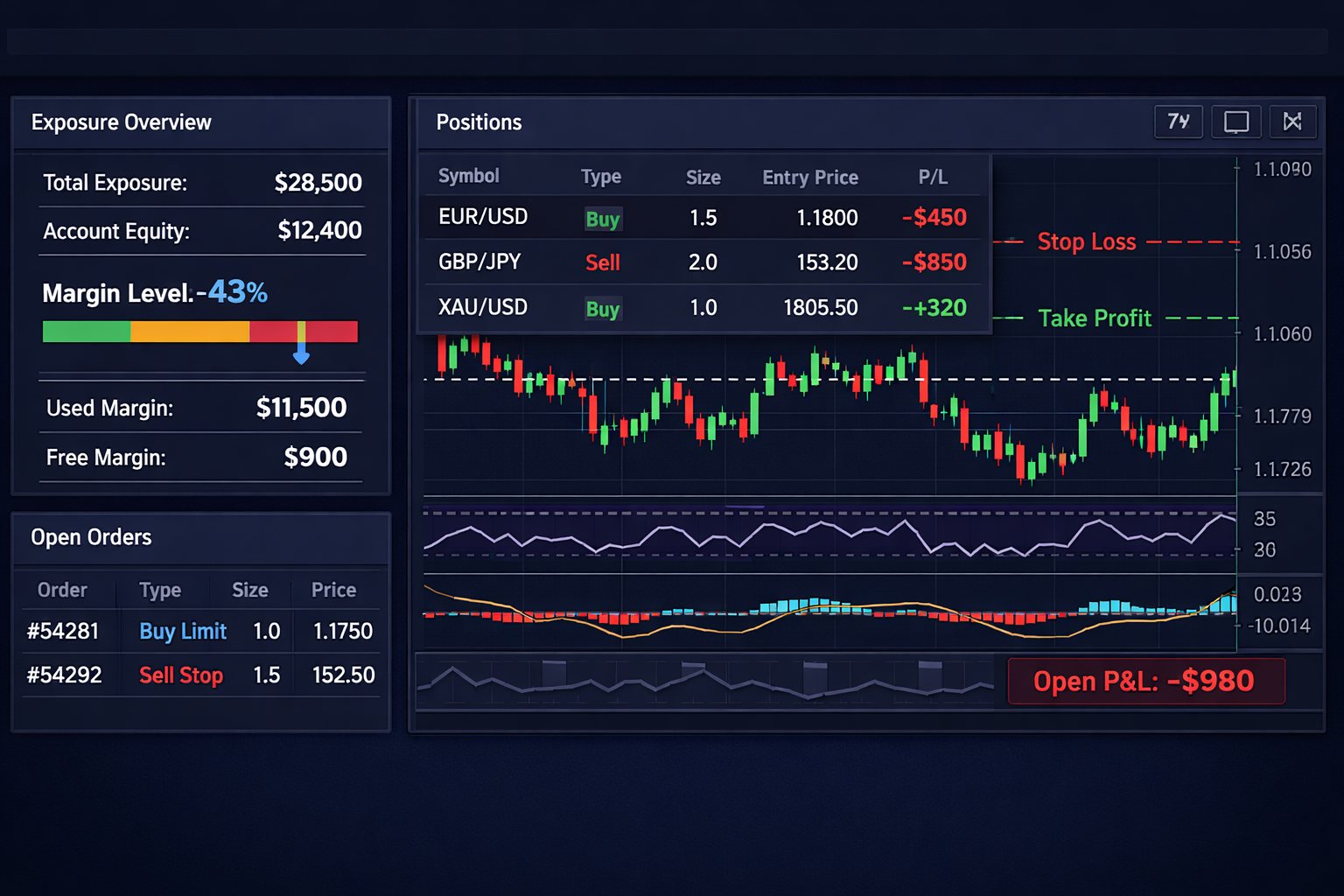
Let’s say you’re a trader with $10,000 in your account and five open positions. You’ve set individual stop-loss levels for each trade but haven’t established a total exposure limit yet. As markets fluctuate, the risk per position can rise unexpectedly.
To track total exposure effectively, calculate the total amount at risk across all positions. If you’re risking $500 (or 5% of your account) on each of your five trades, your total exposure is $2,500. This helps you monitor whether your combined risk remains within a comfortable threshold.
What happens if you don’t track this? Without monitoring your total exposure, you might end up overtrading and risking more than the recommended 10%. If markets turn against you, each position’s losses could quickly add up. Your initial $2,500 in risk could grow to $4,000 due to market volatility.
To prevent such scenarios, set a strict upper limit for total exposure – say 15% of your account. For an account balance of $10,000, this would be $1,500. Adjust this figure as needed based on market conditions and personal risk tolerance.
By setting clear limits, you maintain financial control and avoid overextending in turbulent markets. Consider journaling techniques to track your exposure continuously.
How would you adjust your total exposure limit if market volatility increases significantly?
Avoiding Common Exposure Management Mistakes
What are the common mistakes you should avoid when managing your total trading exposure? Here’s how to stay on track:
- Not setting strict position limits: Always define maximum trade sizes and overall exposure caps. For instance, limit each trade to no more than 2% of your account balance.
- Ignoring stop-loss orders: Set consistent stop-loss levels based on your risk tolerance. Skipping this step can lead to significant losses.
- Relying too much on gut feelings: Use tools like the Relative Strength Index (RSI) to confirm entry and exit points instead of relying solely on intuition.
- Not keeping a trading journal: Document each trade’s risk metrics, such as position size and exposure. A trading journal helps you track performance and spot patterns over time.
Common Pitfall: Not reviewing and adjusting your exposure limits regularly can leave you vulnerable when markets change suddenly.
To avoid these mistakes, make sure your trading journal includes detailed records of each trade’s risk parameters and continuously evaluate your total exposure against predefined caps. For more guidance on managing a trading journal, check out Trading Journal – Flows Trading.
Common Risk Management Pitfalls for Beginners
What are some common risk management mistakes that beginners often make? Here’s a list of pitfalls to watch out for:
- Not documenting risks per trade: Keeping a detailed trading journal is crucial for tracking past mistakes.
- Failing to monitor exposure: Not keeping an eye on your total exposure across all positions can lead to big losses.
- Setting stop-loss levels incorrectly: A stop-loss that’s too tight or too loose can result in unnecessary losses or missed profits.
- Skipping regular reviews and adjustments: Neglecting to revise your risk management strategies based on trading performance leads to suboptimal results.
- Ignoring position sizing principles: Position sizing without considering your account balance and trade risk percentages exposes you to more risk than necessary.
For example, setting a broad stop-loss might seem protective but can result in larger losses when the market moves against you. Regularly reviewing your trading journal for patterns that indicate poor risk management is key. Trading signals and technical indicators like RSI can help refine your strategy, but only if you’re diligent about tracking them.
By actively identifying and correcting these mistakes, beginners can significantly improve their risk management practices. Not regularly reviewing and adjusting based on trading performance can lead to significant financial losses due to poor decision-making habits.
Synthesizing Your Risk Management Strategy
When putting together your risk management strategy, start by digging into your trading journal entries to find patterns and results. Here’s how:
- Gather Data: Take a look at at least 30 trades in your journal.
- Identify Patterns: Notice common mistakes, winning strategies, and emotional triggers.
- Document Risk Per Trade: Write down the risk percentage you’re willing to take on each trade.
- Set Stop-Loss Levels: Use Setting Stop-Loss Levels guidelines based on your journal data.
- Determine Position Size: Decide what percentage of your account balance you’re willing to risk per trade, using Position Sizing Importance principles.
- Track Total Exposure: Keep an eye on and document your total exposure regularly to make sure it matches your risk tolerance.
Avoid the common mistake of creating a one-size-fits-all strategy without considering your unique trading patterns. Tailoring your approach based on real data helps you stay in control financially and reduces risks.
Without this personalized touch, new traders might struggle to create an effective risk management plan. How do you plan to use these steps to improve your current trading strategy?
Introduction to Risk Management, Position Sizing, and Exposure Tracking
Effective risk management is a cornerstone of successful trading. It involves understanding how much you can afford to lose on each trade (position sizing) and tracking your overall exposure to ensure it remains within acceptable limits. These practices are crucial for maintaining long-term profitability in the markets. For instance, technical analysis tools like the Relative Strength Index (RSI) indicator can help assess risk by identifying overbought or oversold conditions in a market (see this guide for more details). Additionally, keeping a trading journal is an invaluable practice that helps traders document their decisions and outcomes, thereby improving future decision-making processes. This article will explore the importance of these strategies and provide insights on how to implement them effectively.
Related Articles
To deepen your understanding of risk management, position sizing, and exposure tracking, consider exploring the following articles from our academy:
- Technical Analysis – Discussing market behavior and trends.
- Metrics Trading Signals – Explaining the importance of performance tracking.
- 5 Technical Indicators for Beginners – Introducing visual analysis methods for identifying trends.
Apply with Flows
Flows Trading offers a comprehensive suite of tools to help traders manage their risks and optimize their trading strategies. By leveraging our platform, you can integrate technical indicators like the RSI into your analysis workflow (learn more). Additionally, using our trading journal app allows you to keep detailed records of your trades and monitor your performance over time. This integration ensures that you have all the necessary information at hand to make informed decisions.
- Risk Assessment: Utilize technical indicators such as RSI for better risk management.
- Position Sizing: Use our platform’s tools to determine optimal trade sizes based on your risk tolerance.
- Exposure Tracking: Monitor your overall exposure and adjust accordingly with real-time data.
Further Reading
For more in-depth information on improving trading decisions through journaling techniques, consider reading the following articles:
- Improve Trading Decisions with Journaling – Discusses how to improve decision-making through record-keeping.
- Learn Different Types of Chart Patterns – Compares tools that help in tracking trading performance and risk exposure.