


What to Record Before, During and After Trades: A Beginner's Guide
Table of Contents
Why Beginners Overlook Recording Trade Information
When you first start trading, you’re eager to make those big wins right away. But instead, you might find yourself forgetting key details about your trades. This can be frustrating when trying to figure out what went wrong or right.
For example, after a losing streak, you might remember feeling unsure but not the specific reasons why, like market conditions or decisions you made during the trade.
New traders often skip recording trade information because they think they’ll remember everything clearly later on. But this can be a big mistake. Relying solely on your memory means you miss out on learning from both wins and losses.
Take, for instance, trying to recall why a particular trade went south. You might forget important details or get them mixed up.
The truth is, without proper documentation, you’re missing out on valuable insights that can help improve your trading strategies. Logging trades helps you spot patterns, refine risk management, and boost overall performance.
Start journaling now so you capture all the crucial details of each trade.
Common Mistakes in Pre-Trade Preparation
Skipping the step of setting stop-loss orders before entering trades can lead to big financial losses, as beginners often forget this crucial safety measure.
Another common mistake is overestimating your risk tolerance. Jumping into high-risk trades without thinking about the potential impact can cause stress and poor decision-making under pressure.
Neglecting technical analysis before trading is another error. Relying on gut feelings instead of analyzing charts and indicators increases the chances of entering a trade at an unfavorable price or timing.
Skipping post-trade evaluations hinders your growth because you miss out on valuable insights needed to refine your strategy.
Not keeping a detailed record of each trade makes it harder to track performance over time. A trading journal is essential for spotting patterns and improving your approach.
Failing to update your risk management strategies as you gain experience leaves you vulnerable to unexpected market conditions, leading to missed opportunities or unnecessary losses.
Example Scenario: Jane, a new trader, enters a volatile trade without setting a stop-loss and loses her entire investment when the market turns against her unexpectedly.
Link: For more on improving your trading decisions through journaling, see improve decisions.
Next Step: Start keeping a detailed trading journal to track trades and identify areas for improvement.
Critical Pre-Trade Planning Essentials
Before diving into the market, it’s crucial for beginners to plan carefully to avoid financial losses due to poor decisions or lack of preparation. Here are some key essentials:
- Figure out how big each position should be based on your account balance and your comfort with risk.
- Set stop-loss levels to limit potential losses.
- Use technical analysis tools to report recent trends.
- Write down your plan in a trading journal before you start.
Common mistake: Not setting exit points can lead to emotional decision-making during trades.
Skipping these steps leaves beginners vulnerable to financial risks. Start by defining your trade goals and risk limits today to avoid common pitfalls.
Steps for Pre-Trade Preparation
Before jumping into a new trade, take some practical steps to set yourself up for success and avoid unnecessary risks:
- Log in and get the latest data: Make sure your trading platform is connected and that you have access to the most recent market information.
- Review the news: Stay updated with any relevant market news or updates related to the assets you’re interested in.
- Set clear goals: Define your entry and exit points, including take-profit and stop-loss levels, to prevent emotional decision-making during volatile times.
- Configure risk management settings: Set up your trading platform to automatically enforce your risk limits.
- Keep a journal: Document the details of each planned trade, including your reasoning and initial forecasts for future reference.
Use technical analysis tools like chart patterns or moving averages to identify potential entry points that align with broader market trends and your trading strategy. If you haven’t already, simulate trades in a demo account to get comfortable with the process under realistic conditions.
Lastly, review past successful trades to reinforce good habits and spot areas for improvement before risking real money. Make sure your trading environment is distraction-free and stable to help maintain discipline.
By following these steps carefully, you can build confidence and minimize costly mistakes.
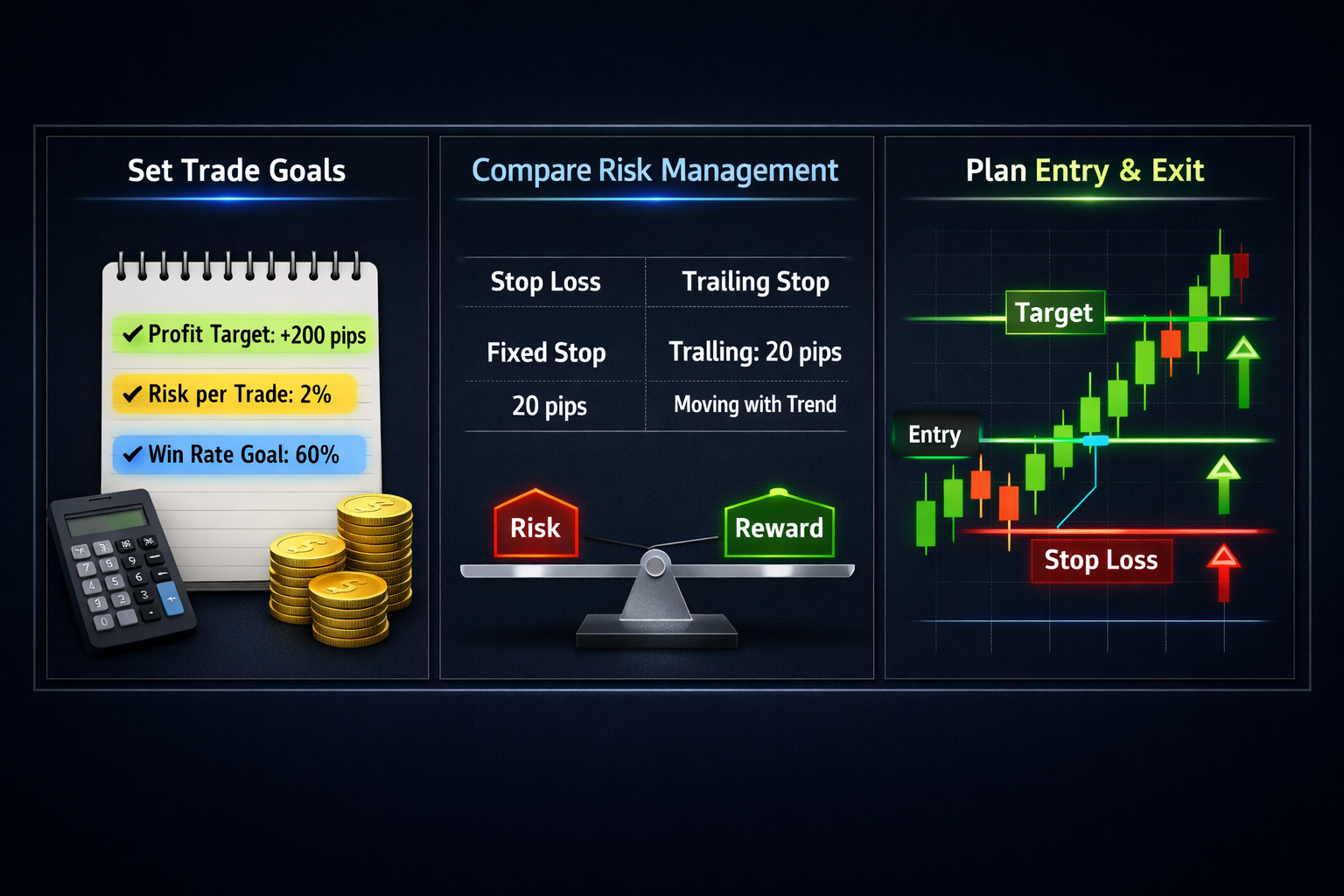
Setting Clear Trade Goals
How do you set clear trade goals that match your risk tolerance and financial objectives? Here’s how beginners can establish realistic targets:
- Define Your Risk Tolerance: Figure out the most you’re willing to lose on any single trade. For example, if you have $10,000 in trading capital, decide not to risk more than 2% per trade.
- Set Profit Targets and Stop-Loss Levels:
- Use market analysis or technical indicators to set a practical profit goal, like aiming for a 5% gain.
- Place your stop-loss order at an appropriate level to protect your investment. For instance, if you enter a trade at $100 per share, place the stop loss at $97.
- Log Your Trade Goals: Write down both targets before trading so you stay clear and accountable.
Avoid vague goals like “make money fast” or overly ambitious profit expectations without considering market conditions. Vague goals can lead to poor decisions and higher risk.
Next Step: Start setting clear, realistic trade goals by reviewing each upcoming trade against these guidelines today.
Comparing Risk Management Strategies
Understanding risk management is crucial for beginners to safeguard their trading capital effectively. Focusing only on profit maximization without proper risk management can lead to significant financial losses.
Here are three common strategies:
- Fixed Percentage
- Stop-Loss Orders
- Position Sizing
| Strategy | Pros | Cons |
|---|---|---|
| Fixed Percentage | Ensures consistent risk allocation regardless of market conditions; easy to automate | Can lead to overtrading during volatile markets |
| Stop-Loss Orders | Protects capital by limiting maximum loss per trade; provides psychological comfort | May be triggered prematurely by sudden price movements |
| Position Sizing | Flexible based on individual risk tolerance and market conditions | Requires constant monitoring and adjustment |
Fixed Percentage Strategy: This approach involves risking a fixed percentage of your account, like 1%, ensuring you can handle more losses before running out of capital. However, it might lead to overtrading in volatile markets.
Stop-Loss Orders: These automatically close positions at a predetermined price level, protecting against significant losses and providing psychological comfort. But sudden market moves can trigger them prematurely.
Position Sizing: This strategy adjusts the size of each position based on your risk tolerance and current market conditions, offering flexibility but requiring constant monitoring.
By understanding these strategies, beginners can better protect their investments from potential losses. To enhance your risk management skills further, explore more about setting stop-loss orders here.
Data to Track During Trades
To boost your trading outcomes, keep track of specific data points during trades. Start by noting the entry price and time for each trade, along with your stop-loss and take-profit levels. Also pay attention to key indicators like moving averages and RSI.
Include any relevant news events and position sizes relative to your account balance in your records. Write down why you made each trade so you can analyze it later. Keep an eye out for chart patterns such as head-and-shoulders or double tops, which can help predict price movements.
Skipping these metrics means missing important insights into your performance. Relying solely on profit and loss figures can lead you astray when evaluating your strategies. For more detailed tips, check out trade recording tips.
Documenting Market Conditions
Alice opens her trading platform and sees EUR/USD cross above its 50-day moving average, which could signal a potential uptrend. Here’s how she documents this:
- Date and Time: She writes down the exact moment it happened.
- Market Indicator: Alice notes “EUR/USD crossed above 50-day MA.”
- Additional Context: Noting the trading volume can help identify stronger market momentum.
By recording these details, Alice can review how EUR/USD performed after the crossover and understand whether the trend is strong and sustainable for future trades. If she misses this information, she might overlook key insights that are important for making informed decisions. For example, ignoring a significant increase in trading volume could mean underestimating the importance of the event.
Using a structured template like this trading journal can help ensure thorough documentation and make it easier to spot patterns over time, improving your overall trading strategy.
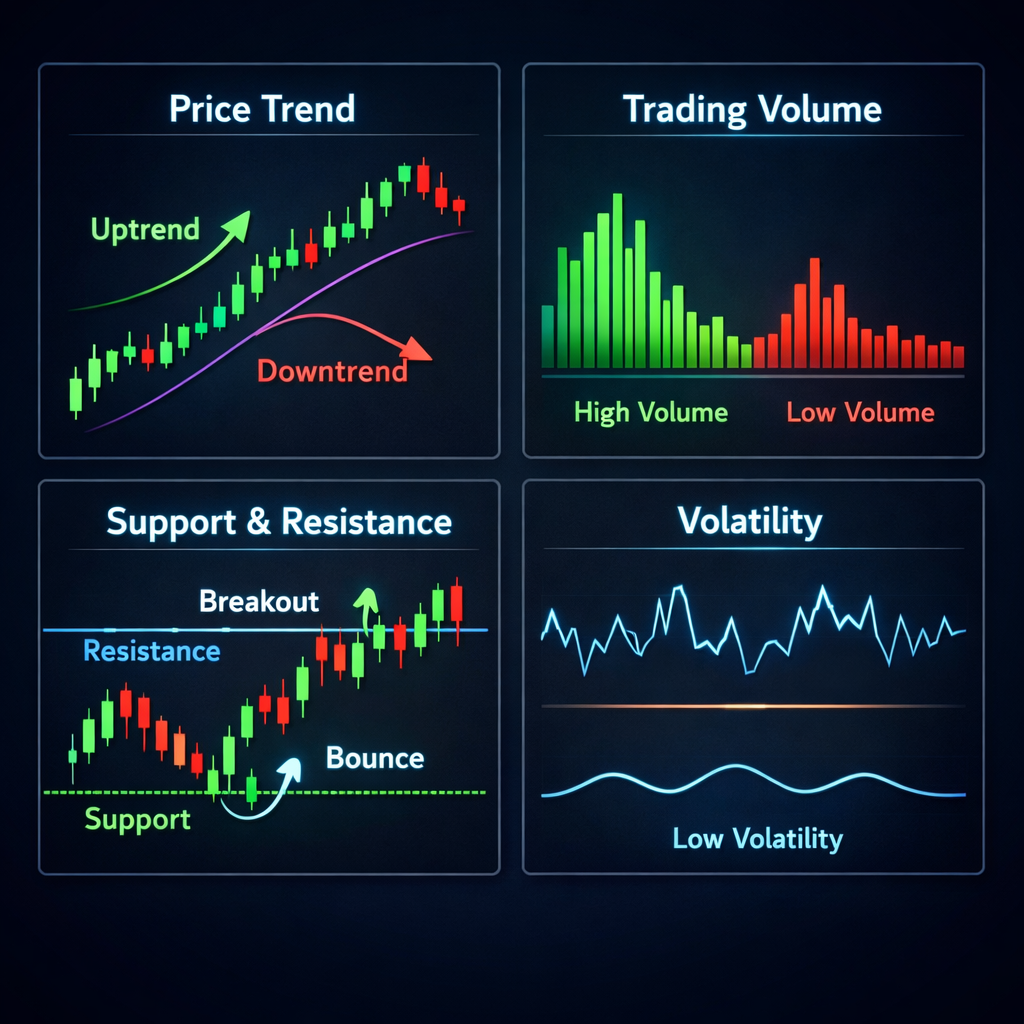
Recording Strategy Changes
Why should beginners document changes in their trading strategies during live trades? Not doing so makes it hard to tell what works and what doesn’t, which slows progress and leads to repeating the same mistakes. For example, if you switch from using a 50-day moving average crossover to focusing on support level breaks without writing down why, it’s tough to know later whether that change actually helped.
Keeping a trading journal is crucial for tracking these changes as they happen. As soon as you tweak your stop-loss levels or adjust position sizes, write it down. This way, you can see which tweaks are actually making a difference and which ones aren’t working out.
For instance, if candlestick patterns keep leading to false breakouts, switching to Bollinger Bands might help refine your entry points. By keeping detailed records, beginners can learn from real data and improve their trading skills.
So, how will you start documenting your strategy changes today?
Post-Trade Evaluation Essentials
What should you review after making a trade? Here’s a checklist to help beginners evaluate their trades and improve future strategies:
- Trade execution: Did you stick to your planned entry and exit points, or did emotions take over?
- Trading signals: Compare the actual results with what prompted the trade.
- Risk management: Did your stop-loss orders work as intended to limit losses?
- Document outcomes: Record profits, losses, and any unexpected events during the trade.
- Market conditions: Note how news or economic data affected your trade.
- Strategy adherence: Did you follow your trading plan strictly, or did you change course based on new information?
- Update journal entries: Log insights in a dedicated trading journal for future reference.
Failing to learn from emotional decisions can lead to repeating the same mistakes. Ignoring post-trade analysis means missing out on valuable lessons that could help improve your strategy.
Instead of just cursing poor trade results, treat each trade as an opportunity to learn and refine your approach. Learn how to track trades successfully for better outcomes.
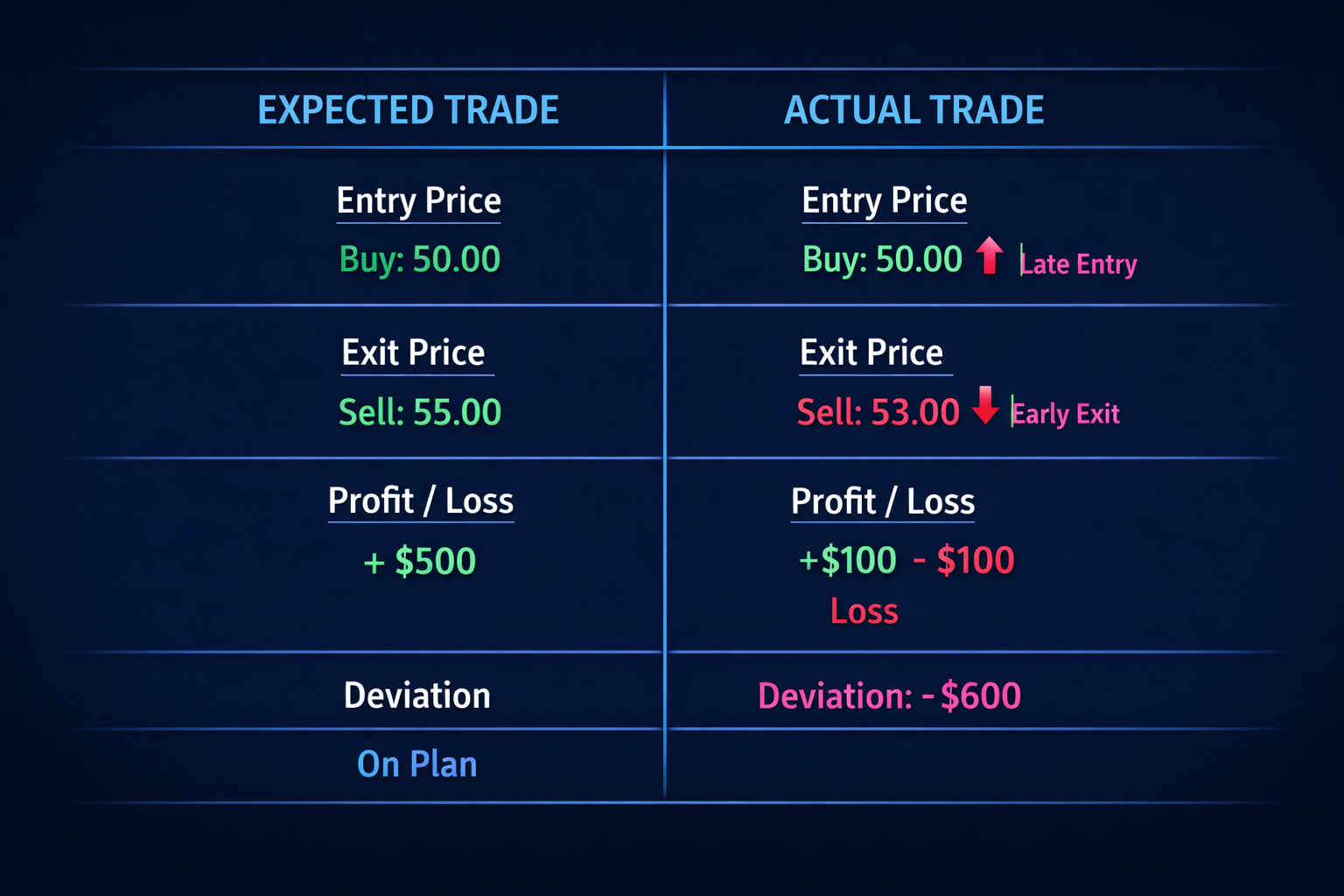
Comparing Actual vs Expected Outcomes
When comparing actual vs expected outcomes in trading, follow these steps:
- Set clear goals before you trade by defining your target profit and acceptable loss levels. For example, if you plan to buy EUR/USD at 1.2000 with a stop-loss at 1.1950 and a take-profit at 1.2060.
- Track actual outcomes once the trade is closed. If you exited at 1.2040, note this as your actual outcome.
- Compare expected profits or losses to what actually happened. For example, if you were aiming for $35 but ended up with only $28 due to market movements, figure out why there was a difference.
- Document the reasons behind any discrepancies. Did it happen because of unexpected volatility? Did your trading signals change?
- Don’t assume success without proper analysis. If your expected 5% gain turned out to be just 2%, don’t dismiss this as bad luck.
Example Scenario: Let’s say you bought a stock for $95 with the goal of selling at $105, aiming for a $10 profit. But due to unexpected market news, you had to sell it at $102 instead. Analyze why your actual outcome was different from what you expected.
By following these steps, beginners can identify areas for improvement based on real-world performance and avoid common pitfalls like sticking with ineffective strategies. This disciplined approach helps enhance trading skills over time.
Influencing Factors Comparison
When evaluating trade outcomes, it’s important to look at external factors that might have affected your results. Ignoring them can lead you to misunderstand why a trade worked or didn’t work.
Three key influencers are market conditions, trading signals, and economic events:
| Factors | Market Conditions | Trading Signals | Economic Events |
|---|---|---|---|
| Definition | The current state of financial markets, including trends and volatility. | Indicators based on historical data to predict future movements. | Announcements or developments that directly impact currency values. |
| Impact | Changes can significantly affect trade outcomes by altering price movements and volume. For example, a sudden spike in market volatility can invalidate trading strategies. | Signals provide guidance but may become unreliable during high uncertainty or low liquidity periods. | Events like central bank decisions have direct effects on currency values, requiring adjustments to your trading plan. |
| Winner | Most dynamic; needs real-time adjustments. | Offers consistency but requires recalibration in volatile markets. | Provides clear triggers for strategic changes but demands proactive preparation. |
Market conditions can change rapidly and force you to adapt quickly. For instance, if Alice sees EUR/USD crossing its 50-day moving average, she adjusts her trades.
Trading signals are helpful but may not work well during market volatility. Beginners should be cautious and avoid relying solely on signals without considering the broader market context.
Economic events provide clear triggers for strategic changes. An unexpected interest rate hike can drastically change currency values, requiring quick adjustments.
Recognizing these factors helps prevent you from attributing trade outcomes to personal strategy alone rather than acknowledging external influences. What other external factors do you think traders should consider in their evaluations?
Applying Lessons Learned
If you’re a new trader who recently entered the market based on a sudden spike in volume rather than waiting for confirmation from your usual technical indicators, it’s important to document what happened.
Step 1: Write down exactly when you made the trade, whether you made money or lost it, and why you deviated from your plan. For example, did you act impulsively because of a news event?
Step 2: Think about if similar situations might come up again in the future. If high volume spikes often happen with news releases that increase volatility, adjust your trading signals to account for these events. Trading signals can help you spot such patterns.
Step 3: Update your trading journal to include sections for unexpected market events and their impact on your strategy. This will help you see when it’s okay to deviate from your usual approach and when sticking to the plan is better.
If you don’t apply these lessons, you might end up making the same mistakes over and over again. Relying too much on emotional responses instead of analyzing why things went wrong can hurt your trading performance. By taking a disciplined approach through post-trade analysis, you’ll avoid repeating errors and improve your skills continuously.
Introduction to Higher-Level Trading Concepts
Trading at a higher level involves understanding complex market behaviors and utilizing advanced strategies. One such approach is flow trading, which focuses on the dynamics of supply and demand in the markets. To master flow trading, it’s essential to delve into technical analysis, as explained in this comprehensive guide. This method helps traders identify key chart patterns that can signal potential market movements.
- * Flow trading strategies rely on understanding market behavior
- * Technical analysis is crucial for identifying trends and signals
Related Articles
To further your knowledge in higher-level trading concepts, consider these related articles that provide deeper insights into the topics discussed above:
- * Learn Different Types of Chart Patterns – Understanding various chart patterns can enhance your ability to predict market movements.
- * Improve Trading Decisions with Journaling – Keeping a detailed trading journal can significantly improve decision-making skills.
Apply with Flows
To apply these higher-level concepts effectively, it’s important to track your performance and refine your strategies. Metrics Trading Signals offers a powerful toolset for monitoring key trading metrics and signals. This can help you make informed decisions based on real-time data.
- * Use Metrics Trading Signals to monitor performance
- * Refine your strategies with real-time market insights
Further Reading Links
For those looking to deepen their understanding and improve their trading process, these additional resources are highly recommended:
- * Trade Recording: What to Log Before, During, and After – Learn the importance of logging detailed trade information.
- * How a Trading Journal Improves Your Professional Process – Discover how maintaining a trading journal can enhance your overall professional process.