


How to Structure a Trading Journal for Beginners
Table of Contents
Why Relying Solely on Win/Loss Records is Misleading for Beginners
You’ve been tracking your trades diligently and noticing how many you win or lose, but your account balance isn’t reflecting the high win rate you’ve achieved. This might make you feel like a successful trader, only to discover that profitability remains elusive despite consistent wins.
Relying solely on win/loss records can be misleading because it doesn’t capture the full picture of your trading performance. For instance, imagine ten trades where each winning trade yields $500 and each losing trade costs $1,000. Even though 80% of these trades are wins, your overall loss is significant due to the higher risk taken on losing trades.
This misinterpretation can lead to poor decision-making as it overlooks crucial factors such as the size of gains and losses, skewing your perception of success. Understanding risk-adjusted returns reveals a more accurate picture than simple win/loss ratios. Therefore, comprehensive trade documentation is essential for beginners to avoid making decisions based on incomplete data.
Key Elements for Comprehensive Trade Documentation
To accurately track your trading activities and analyze your performance effectively, include these key elements in your trade documentation:
- Trade Date: Record the exact date of each trade to correlate it with market conditions.
- Entry Price: Note the price at which you entered the position for precise risk assessment.
- Exit Price: Document the exit price to measure actual profit or loss accurately, not just win/loss outcomes.
- Position Size: Log how many units were traded to understand leverage and exposure.
- Stop-Loss Level: Include your stop-loss setting to evaluate risk management decisions.
- Risk/Reward Ratio: Specify the ratio between potential loss and profit target. A high ratio can indicate overconfidence or poor planning.
- Trade Idea or Reasoning: Explain why you entered this trade, such as recognizing a technical pattern or fundamental insight.
- Market Conditions: Note broader market context at the time of trading, like economic news or sentiment trends.
Scenario Example: If you buy 10 shares of XYZ Corp on January 3rd for $50 per share with a stop-loss set at $47 and a target price of $60, ensure these details are logged to understand your strategy’s performance comprehensively.
By including all these elements, you avoid relying solely on win/loss data. This comprehensive documentation helps refine future trades by providing critical information for accurate analysis.
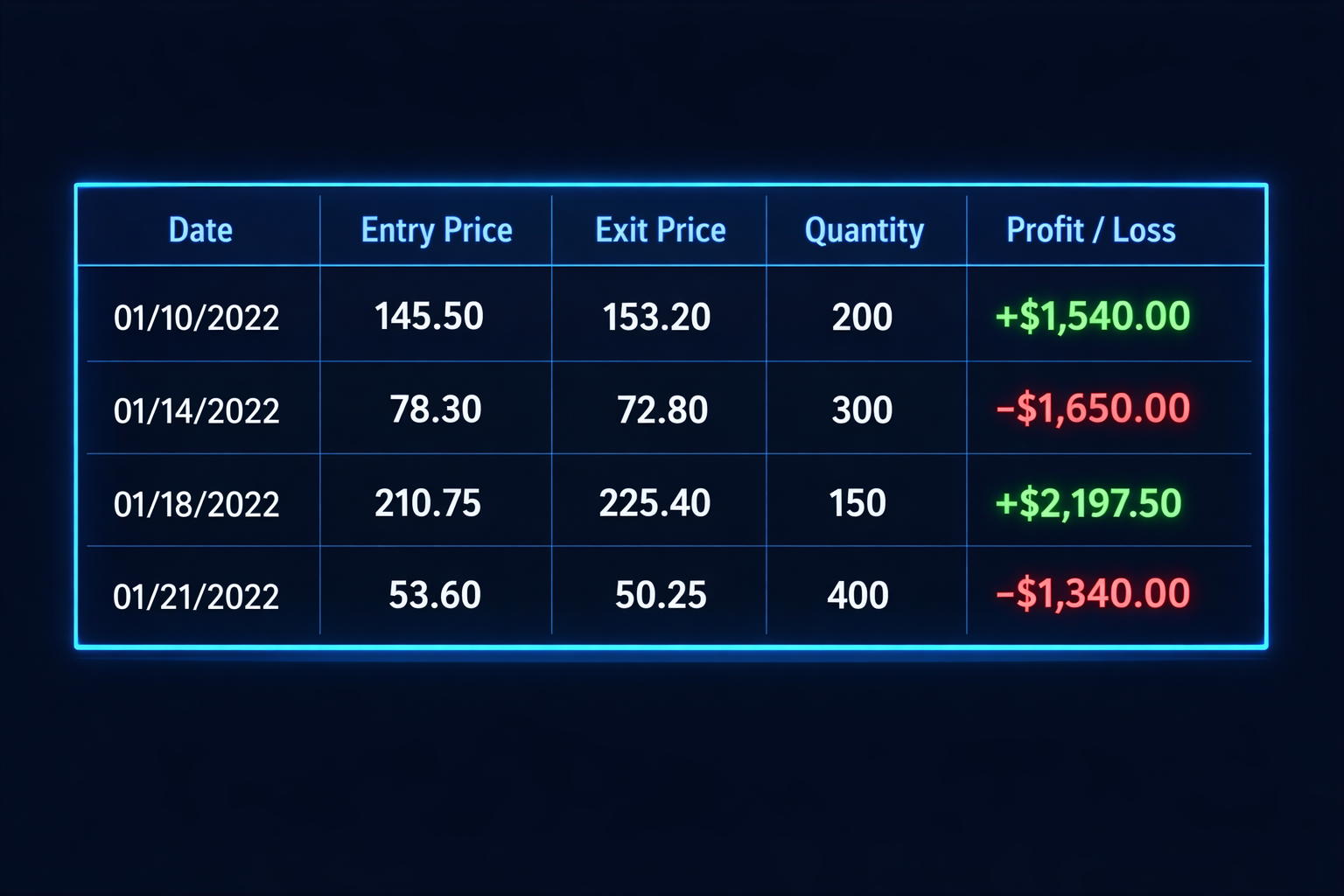
Recording Each Trade with Essential Details
Imagine you’re Jane, a beginner trader who just executed your first trade on Monday by buying 10 shares of XYZ Corp at $50 per share with a stop loss set at $48 and take profit levels at $53 and $55. Here’s how to accurately document this transaction in your trading journal.
Start by noting the exact entry price: $50. This is crucial for calculating precise gains or losses later on. Record the exit price if you sold immediately, like selling at $49 due to market volatility. If still holding, mark it as “pending.”
Include your stop loss and take profit levels—$48, $53, and $55 respectively—to assess risk management effectiveness.
Document your position size: 10 shares of XYZ Corp. This is essential for understanding the impact on your account balance and overall portfolio performance.
What would go wrong if you only recorded whether this trade was a win or loss without these specifics? You’d miss critical insights into market conditions’ effect on decision-making, hindering future strategy improvements based on past mistakes.
By recording all details meticulously, Jane can track trades comprehensively and gain valuable analytical insights. What’s the next piece of information you’d include in your journal for this trade?
Handling Multiple Entries Per Position
How do I manage multi-entry positions? Properly tracking multiple entries for the same position is essential for accurate performance analysis and risk management. Here’s what beginners need to know:
- Create Separate Entries: For each entry, add a new line in your trading journal with all relevant details (date, price, quantity). This helps you keep track of individual trades.
- Adjust Stop Losses Individually: After entering multiple times at different prices, adjust stop losses accordingly. Record these changes to reflect the specific risk level for each entry.
- Document Entry Costs and Averages: Track the cost basis separately for each entry. Calculate the average price if you plan to manage them collectively later.
Without proper guidance, beginners often fail to accurately track multiple entries, leading to confusion about trade performance and risk management. Ignoring separate entries or failing to update stop losses can lead to miscalculations in profit/loss analysis and unnecessary risks.
By meticulously documenting each entry with its own parameters, you ensure transparency and control over your trades. Now apply these guidelines to your next multi-entry position to improve your trading journal’s accuracy.
Next Step: Apply these methods to your latest trade in your journal now.
Tracking Partial Fills and Scaling Positions
Imagine you’ve executed a trade for 10 shares of ABC Corp at $50 per share, but your broker only fills part of your order, say 6 shares. How do you document this partial fill accurately in your trading journal?
Tracking Partial Fills: When tracking partial fills, log the exact number of shares filled and their price separately from any remaining unfilled orders:
| Scenario | Shares Ordered | Filled at $50 | Remaining Order |
|---|---|---|---|
| Initial Entry | 10 | 6 (partial fill) | 4 |
Failing to track partial fills can misstate your average entry price and performance analysis, leading to flawed trading effectiveness assessments. By logging each fill accurately, you maintain precise records.
Scaling Positions: When scaling positions—adding or reducing shares based on market conditions—document each adjustment clearly:
| Date | Action | Shares Added/Reduced | Price at Addition/Reduction |
|---|---|---|---|
| 2023-10-05 | Add to Position | +4 | $51 |
| 2023-10-07 | Reduce Position | -2 | $53 |
This ensures accurate calculation of your average entry price and reliable performance evaluation. Adding shares at a higher price than the initial entry affects your overall cost basis.
To avoid common pitfalls, document each transaction as it occurs to maintain precise records of your trading activities. This meticulous documentation prevents errors in your trade journal and provides reliable data for evaluating performance accurately.
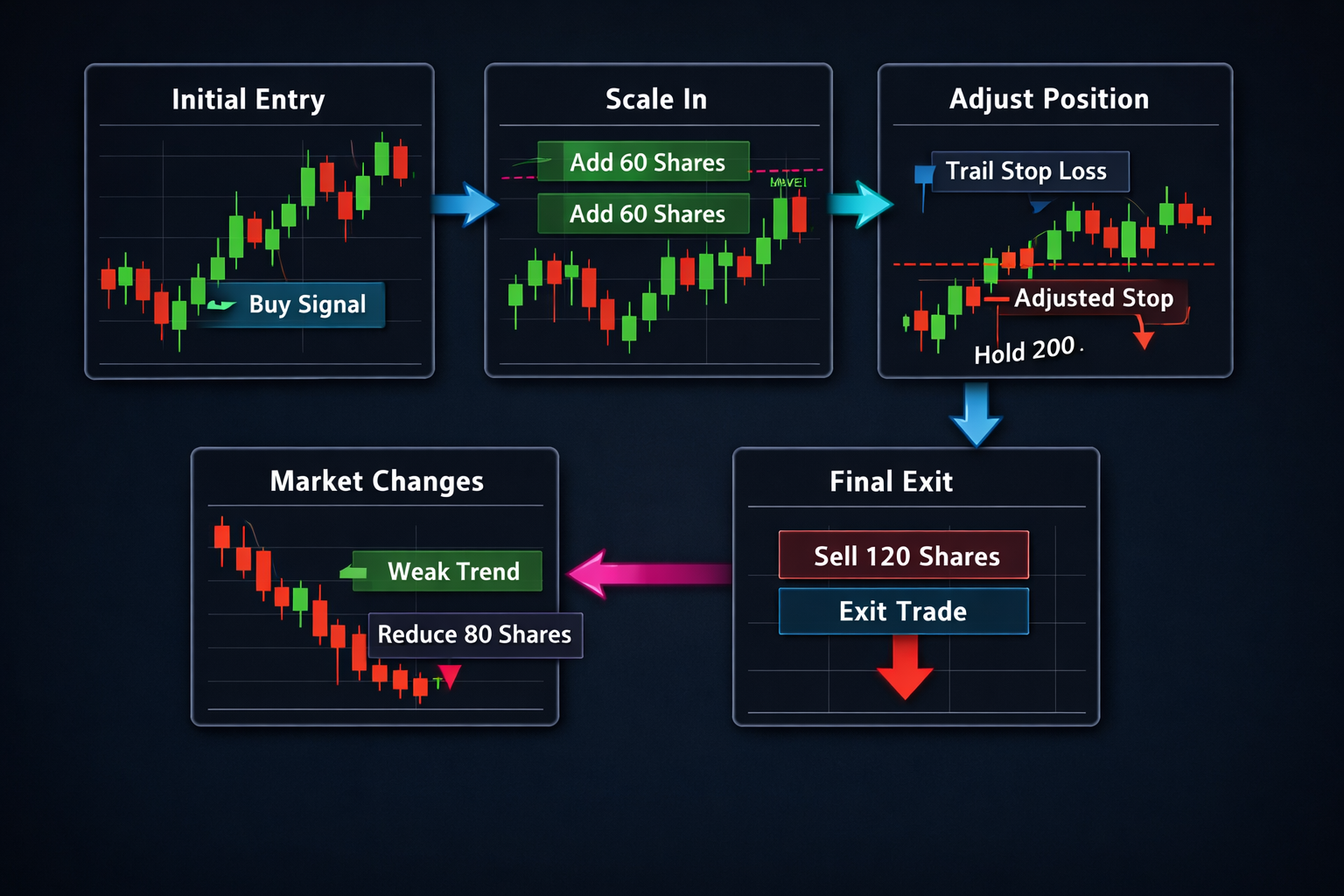
Documenting Partial Fills Correctly
When executing an order for 10 shares of DEF Corp at $60 per share but only receiving 5 shares initially, document each partial fill separately in your trading journal.
- Create a new entry for the initial fill of 5 shares at $60 to track this as its own trade with distinct risk parameters.
- Note the remaining 5 shares as an unfilled order at the same price level to monitor ongoing opportunities and manage risk effectively.
- If only 3 shares are filled due to market conditions, adjust your journal entry accordingly.
Reviewing your trades later, treat each partial fill independently for accurate profit/loss calculations. This precision prevents misinterpretation of position sizes and exit points, crucial for sound risk management.
By logging every partial fill as a distinct transaction, you ensure a clear and reliable record that supports better trading analysis. Apply this method to your next trade journal entry for accuracy.
Scaling Strategies in Trades
Scaling trades systematically helps manage risk and maximize profits. Imagine entering a trade with 10 shares of XYZ Corp at $50 per share. Instead of holding this fixed position, add to your winning positions gradually.
For example, if XYZ Corp rises to $52, you could buy another 5 shares. This technique, called scaling in, can lock in higher profits. Conversely, without a systematic approach, traders might hold too long or exit prematurely due to emotional decisions.
Crucially, cut losses early if the trade moves against you. If XYZ Corp drops below $48, selling some shares limits your overall loss while allowing for potential recovery.
By scaling in on winners and out on losers, you manage risk more effectively and adhere to sound trading principles like patience and discipline.
To apply these strategies, review entries and exits against predefined price targets. This improves your trading journal’s accuracy and helps refine future decisions.
Experiment with different scaling ratios to find what works best for various market conditions.
Common Mistakes in Journal Representation
What mistakes should I avoid when representing trades in my journal?
- Incomplete details: Ensure every trade includes all essential information such as entry and exit prices, order size, and stop-loss levels. Incomplete records can lead to inaccurate analysis.
- Lack of consistency: Stick to a standardized format for recording trades. Variability in your documentation complicates performance review.
- Neglecting emotions: Document your emotional state before and after executing trades. Fear or greed significantly influence trading decisions but are often overlooked.
- Ignoring market context: Include relevant economic news, technical indicators, and market sentiment at the time of each trade. This context is crucial for understanding strategy success or failure.
- Failing to update entries: Continuously revise journal entries with new insights as you gain experience. Initial assumptions might change over time, impacting future strategy.
By addressing these issues, your trading journal will be thorough and accurate, leading to better-informed decisions and improved performance. Do you have any other common pitfalls when documenting trades?
Structuring Entries for Single vs Multi-Entry Trades
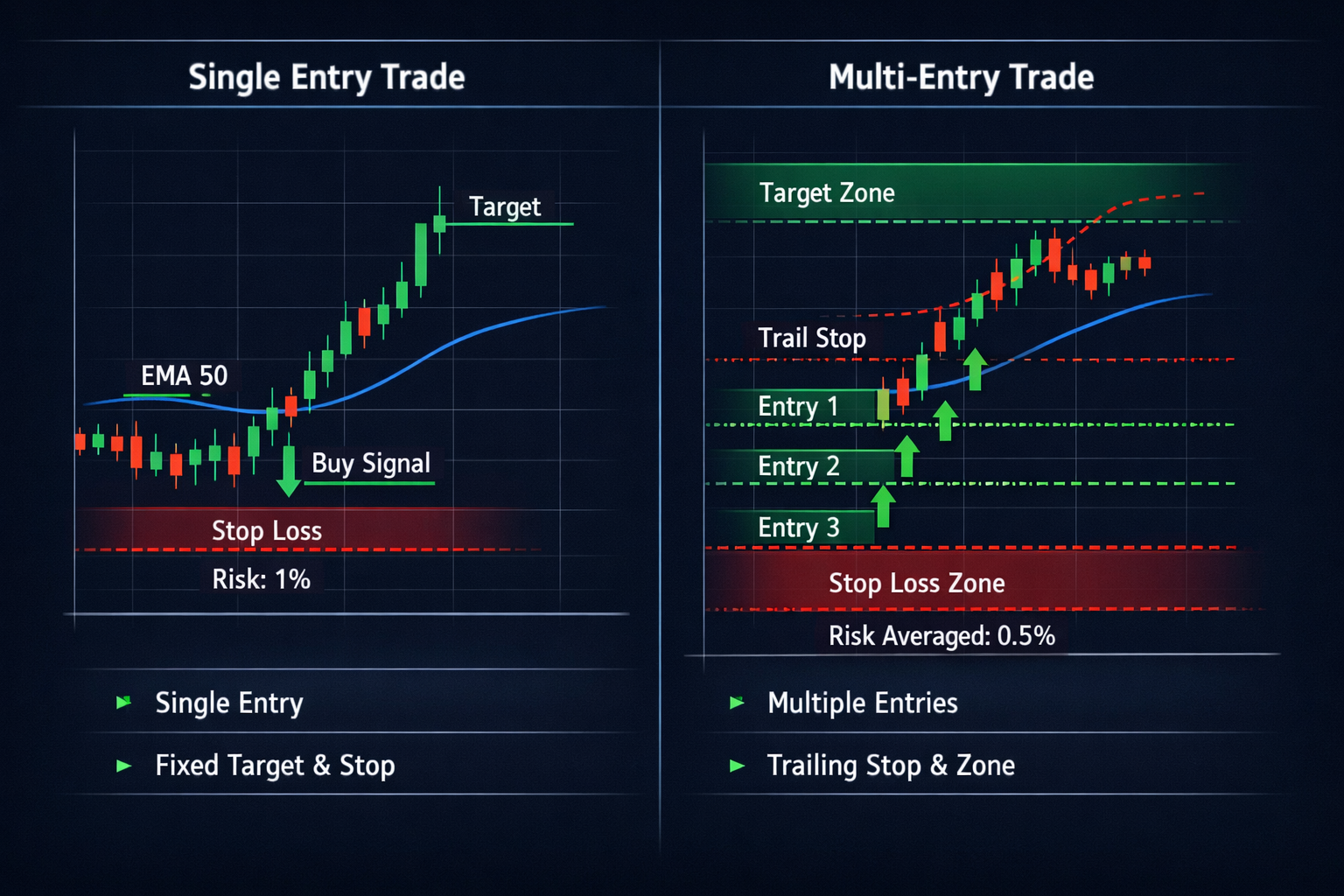
Identify whether your trade involves a single entry or multiple entries based on the number of times you buy shares into the same position. For instance, if you enter a long position in XYZ Corp twice at different price levels, it’s a multi-entry trade.
For multi-entry trades, create a new journal entry for each transaction. Document each purchase separately to maintain clarity and track multiple entries accurately. Include precise details such as date, time, number of shares, and entry price. For example, buying 10 shares at $50 on Monday and another 10 shares at $49 on Tuesday should be recorded distinctly.
Use a separate section or column for multi-entry trades to prevent mixing up different purchase instances within the same position. Label each entry clearly with unique identifiers like Entry 1, Entry 2, etc., to avoid confusion during review.
For single-entry trades, consolidate all relevant details in one comprehensive record per transaction. Include your initial investment and any additional entries due to scaling up or partial fills on the same day.
If you scale into a position gradually over multiple days, document each incremental purchase as a new entry under the same trade identifier for clarity.
Regularly review and update multi-entry trades by setting separate stop loss and take profit levels for each individual entry. This ensures accurate performance assessment at every step.
Proper structuring prevents confusion and enhances decision-making based on precise records. How will you apply this method to improve your trade documentation?
Understanding Trading Journals
A trading journal is an essential tool for any trader, especially beginners. It serves as a record of your trades, allowing you to track performance and identify patterns that can help improve your strategy over time. By maintaining a thorough trading journal, you not only document the outcomes of each trade but also the rationale behind your decisions. This practice is crucial for learning from both successes and failures.
- * Document every trade’s details
- * Analyze performance trends
- * Learn from mistakes
Why Use a Trading Journal?
Using a trading journal offers several benefits. It helps in assessing the effectiveness of your strategies, understanding market conditions better, and refining your decision-making process. For more detailed insights on why maintaining a trading journal is important, refer to this comprehensive guide which delves into practical tips and best practices.
Expanding Your Trading Knowledge
While mastering the basics of trading is crucial, it’s equally important to delve into higher-level concepts. These advanced ideas can provide a deeper understanding of market dynamics and enhance your overall trading strategy. For instance, learning about technical analysis tools beyond basic indicators or exploring fundamental factors that influence stock prices are steps towards becoming a more informed trader.
- * Learn advanced technical analysis
- * Understand fundamental influences
- * Stay updated with market trends
Resources for Higher-Level Concepts
To further your knowledge in trading, consider exploring resources that cover higher-level concepts. For a broader educational perspective on these topics, visit this extensive resource which offers detailed explanations and practical examples to help you grasp complex trading ideas.